Black Myth: Wukong's mythic saga and blockbuster sales highlight its enduring impact on the gaming landscape in 2026.
I still remember the late August heat of 2024, the way the air shimmered with anticipation. That was the week Black Myth: Wukong erupted onto the gaming landscape like a mythic thunderclap, selling 10 million copies in just three days. Now, in 2026, the title has long since transcended its blockbuster debut to become a living, breathing saga that still hums under my fingertips. The latest expansion, The Unraveling Scroll, dropped only a few weeks ago, and the player count charts are once again warped by a second surge—proof that this Monkey King story refuses to fade quietly.
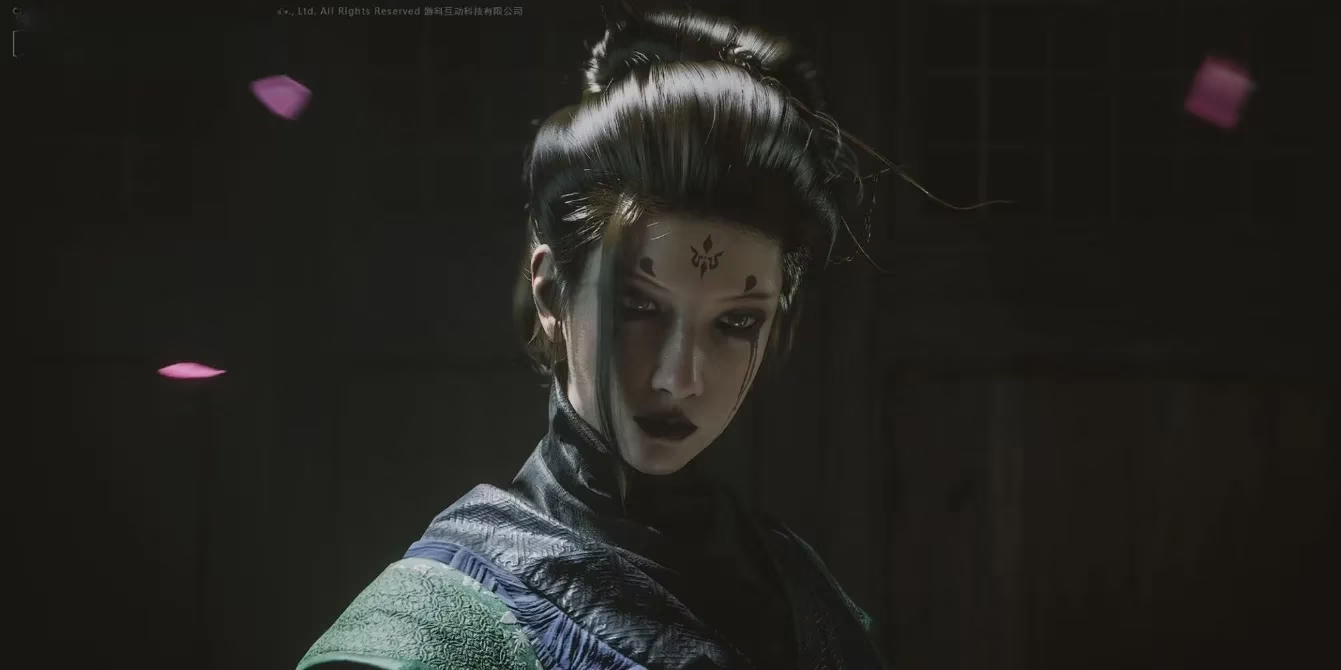
I had no idea, back then, that I was stepping into a canvas where every frame was painted with bloody ink and golden-tailed fury. Game Science had engineered an experience that felt less like a video game and more like a classical scroll come to life—a ribbon of silk unspooling from a forgotten temple. The very first moment I commanded the Destined One to hop onto a cloud, the world tilted open. Leaves scattered in the wind like whispered secrets, and the fur on a demon’s snout bristled with predatory intelligence. That level of detail was not gratuitous; it was the brushwork of a studio that understood the difference between spectacle and soul.
Two years later, my memory of those early days is a kind of beautiful scar. I recall the collective gasp when the game shattered Steam’s concurrent player record for a single-player title, muscling past Counter-Strike as if it were nudging aside a sleepy guard. Twitch numbers touched nearly half a million simultaneous viewers, though we Western players only caught a glimpse of the true frenzy; Chinese streaming platforms, walled off from our statistics, reportedly hosted numbers that turned that figure into a whisper. Watching the global reaction felt like staring at a river during monsoon season—the banks could not possibly hold all that water.
The controversy that briefly crackled through the community, too, now seems like a minor chord in a symphony. I recall the leaked guidelines asking influencers to avoid topics like feminism and COVID-19. Some corners of the internet flared up, but the flames guttered before they could catch. In hindsight, that moment was a wisp of smoke next to the volcano of the game itself. People wanted to talk about the Tiger Vanguard, the seamless transformations, the way the staff combat flowed like calligraphy—rapid, decisive, and deeply rhythmic.
Speaking of combat, anyone who calls Black Myth: Wukong a simple boss simulator never felt their bones rattle during the Yellow Wind Sage fight. It is true that the game sits within the soulslike genealogy, a lineage that demands you memorize death patterns as if learning the stanzas of a brutal poem. Yet the bestiary here sidesteps the genre’s clichés entirely. Each enemy is a unique verse pulled from Journey to the West, twisted into a nightmare that respects its origins. Battling them feels like a dance with a monsoon—unpredictable in direction, devastating in consequence, but so awe-inspiring that you almost welcome the wipe. I remember one dusk when I spent three hours against the Hundred-Eyed Daoist Master, my fingers cramping, my mind hollowed into a state of pure reactive zen. When victory finally came, it wasn’t triumph I felt; it was gratitude, like having been allowed to touch the edge of a celestial spear.
What keeps me returning in 2026 is how the world has continued to bloom. The base game’s 20 million plus lifetime sales (a figure the community has tracked through quarterly publisher reports) have funded a series of free and paid updates that feel generous rather than transactional. A new six-phase mount system now lets the Destined One sprint across landscapes on a crimson-maned lion, and a boss replay arena, the “Memory Pavilion,” has become my personal meditation hall. These additions don’t just extend the game; they deepen it, turning a once-linear pilgrimage into a tapestry that still has loose threads to follow.
I sometimes think of Black Myth: Wukong as a temple bell that keeps ringing. The initial strike was thunderous and singular, but the resonance has proven to be just as important. Communities have carved their own niches—speedrunners who shatter the game in under an hour, lore scholars who dissect every sutra reference, and casual wanderers like me who simply sit on a cliff edge to watch the celestial pagodas drift through the clouds. That is the quiet magic beneath the spectacle: the world remains a place you want to inhabit, not just conquer.
Were you one of the millions who answered the call in that frenzied August of 2024? Or did you, like so many now, arrive later, guided by the legends that sprouted from those first ten million copies? Either way, the mountain still stands. The peach garden still blooms. And somewhere beneath a sprawling peach tree, a monkey with eyes like molten gold is probably laughing at another poor soul learning the same lesson I did: in this world, patience is not a virtue—it is a survival tactic.
I plan to keep walking this path. After all, the scroll does not end until the pilgrim is ready to roll it up.