Salt and Sacrifice blends Soulslike intensity with 2D action RPG elements, offering brutal combat and dynamic multiplayer experiences.
As a player who has spent countless hours dying to FromSoftware's punishing bosses, I have watched the Soulslike genre grow from a niche experiment into one of gaming's most crowded spaces. In 2026, it is easy to forget how many indie and mid-tier studios tried to capture that specific mixture of dread, discovery, and triumph. One of the more memorable attempts came from Ska Studios with Salt and Sacrifice, the follow-up to 2016's Salt and Sanctuary. Even though it launched back on May 10, 2022, I still find myself thinking about its clever translation of the Souls formula into a 2D plane.
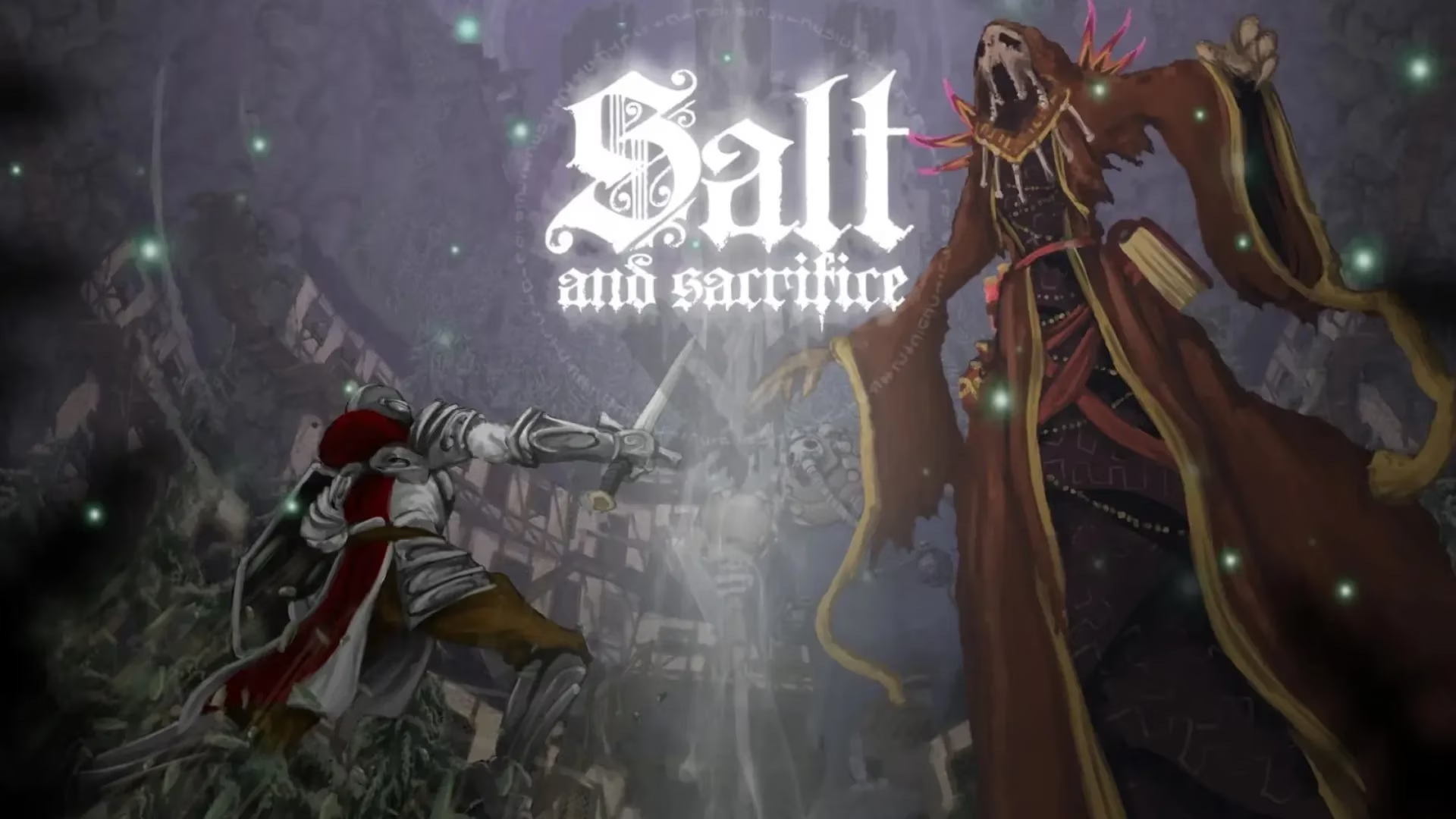
When I first loaded up Salt and Sacrifice on my PS5, I was immediately struck by how faithfully it captured the oppressive atmosphere of the early FromSoftware classics. The reference point is obvious: this is very much a 2D homage to Dark Souls and Demon's Souls. The high-fantasy backdrop is grim and layered, full of crumbling altars, foggy forests, and towering monstrosities that seem to exist only to humble you. Yet the switch to a side-scrolling perspective changes the rhythm of combat in fascinating ways. Instead of circling a boss in three dimensions, you must read horizontal and vertical tells, manage spacing in a narrow lane, and make every jump or roll count.
That commitment to brutal difficulty remains intact. Salt and Sacrifice does not hold your hand. Enemies hit hard, healing is limited, and death carries the familiar sting of losing resources. But the game also builds on the foundation of the original Salt and Sanctuary by expanding the multiplayer side, which in my view is where it truly distinguishes itself. The launch details highlight a healthy assortment of multiplayer options, including:
-
Summoning other players for co-op
-
Engaging in direct PvP combat
-
Invading other players' worlds
This is effectively Dark Souls in 2D, and the multiplayer systems give the world a living, hostile edge that pure solo Souls games sometimes lack.
I think it is worth breaking down what made Salt and Sacrifice stand out in a crowded field. The game arrived at a time when Soulslikes were multiplying across both AAA and indie spaces. Many of those projects struggled to balance homage with originality. Salt and Sacrifice leaned into its 2D identity instead of trying to be a pixel-for-pixel copy of a 3D Souls game. The side-scrolling exploration, interconnected map design, and brutal combat all work together to create a loop that feels familiar but distinct.
Here is a quick summary of the core facts I remember from its launch:
| Feature | Details |
|---|---|
| Genre | 2D Soulslike / Action RPG |
| Developer | Ska Studios |
| Release date | May 10, 2022 |
| Platforms | PS4, PS5, PC |
| Key inspiration | Dark Souls, Demon's Souls |
| Multiplayer | Co-op summoning, PvP, and player invasions |
One thing I appreciate about Salt and Sacrifice is that it does not shy away from the gargantuan boss encounters that define the genre. The bosses are enormous, screen-filling nightmares that often require multiple attempts and careful pattern recognition. In 2D, these fights feel almost like puzzles. You need to learn when to dash under a sweeping limb, when to retreat to a platform, and when to commit to a risky attack. The difficulty is real, but so is the satisfaction when you finally bring one down.
From a modern 2026 perspective, Salt and Sacrifice holds up as an interesting piece of Soulslike history. It launched in the same general window as several other high-profile genre entries, and yet it managed to carve out a niche thanks to its 2D presentation and robust multiplayer framework. I still see players discussing its invasion mechanics and co-op boss fights in community spaces. The game may not have reached the cultural dominance of Elden Ring, but it succeeded in proving that the Soulslike template can flex into different perspectives without losing its essential identity.
That said, I also think Salt and Sacrifice is a reminder of how important it is for developers to understand the core loop before adding systems on top. The multiplayer options are not just tacked on; they reinforce the sense of danger and unpredictability. Knowing that another player could invade your world at any moment changes how you approach exploration. It makes the world feel alive, and it adds a layer of tension that solo play cannot replicate. In many ways, that is the purest expression of the Soulslike philosophy: you are never truly safe.
As I look ahead to the rest of 2026 and the many Soulslikes still in development, I hope more studios take a page from Salt and Sacrifice. The genre does not need every game to be a massive 3D open world. Sometimes a focused, mechanically tight 2D experience can deliver the same emotional highs and lows. Salt and Sacrifice may have released four years ago, but its influence quietly lives on in the indie Soulslike scene, and it remains a game I recommend to anyone who wants to understand why this genre has become so enduring.
Maybe I will boot it up again tonight. The bosses are waiting, and in this genre, waiting is never a good thing.